Module One
The Rainbow Fish

Pfister, M. (1992). The rainbow fish. New York, NY : Scholastic.
The Rainbow Fish tells the story of a beautiful but arrogant fish who soon finds himself lonely after he is unwilling to share his shiny scales with the other less beautiful fish. On the advice of a wise fish, the rainbow fish seeks out an octopus that will tell him what to do to make friends. Listening to the words of the octopus, the rainbow fish opens himself up to sharing with others and friendship, though he must give up something to get it.
This simple tale shares a remarkable lesson about finding true happiness and friendship. This is a worthwhile read for people of all ages, not just the recommended small child. The writing and the illustrations, watercolor artwork, come together to create a deceptively minimal product that is nevertheless thought-provoking and visually stimulating. This book is important for storytime programs where children are able to ask and answer questions about what they can learn from the rainbow fish's experience. Also, as the YouTube video below demonstrates, this could be used for a really nice book trailer. It would be amazing if this book could be used for a teen book club when youths could use a reminder about the principal of sharing and being a true friend.
~ Published Reviews ~
Proud of his shimmering silver scales, Rainbow Fish disdains the plainer fish who asks him to share his treasures. When word of his refusal gets around, Rainbow Fish finds that the other fish swim away at his approach. A wise old octopus advises him to share his scales. When he does, Rainbow Fish finds that the more he gives to others, the happier he feels. The plot is rather predictable, but the artwork certainly catches the eye. Incorporated into the fluid, watercolor paintings, iridescent foil catches every light and radiates colored sparkles that would be the envy of any fish and will fascinate preschoolers. A gimmick? Well, yes, but in context it works. A popular choice for picture book displays.
Phelan, C. (1993). The Rainbow Fish. Booklist, 89(9). Retrieved from http://www.booklistonline.com/
Children will be immediately drawn to this book that features an iridescent, metallic-looking main character whose "scales were every shade of blue and green and purple, with sparkling silver scales among them." Adult suspicions of the gimmick overwhelming the story quickly fade as the plot unfolds: none of the other fish will have anything to do with the Rainbow Fish, who always swims by superciliously and refuses to give away any of his special garb. He is lonely and without admirers until a wise female octopus advises him to give away his scales. Rainbow Fish then discovers that sharing brings happiness and acceptance. The delicate watercolors of underwater scenes are a perfect foil to the glittering scales that eventually form a part of each fish's exterior. This is certainly a story written to convey a message, but in its simplicity, it recalls the best of Lionni. Besides, what three-year-old doesn't need reinforcement about sharing?
Fader, E. (nd). The Rainbow Fish. Library Journal, 89(9). Retrieved from http://www.libraryjournal.com/
Included below is a YouTube video of a creative endeavor using The Rainbow Fish story.
_________________________________________________________________________
Module Two
The Hundred Dresses

Estes, E. (1944). The hundred dresses. New York, NY: Harcourt, Brace and Co.
One little girl's one hundred dresses initially bring her ridicule but later bring her esteem in this story of friends and "frenemies." Wanda Petronski claims to have pretty dresses lined up in her closet but wears the same faded blue dress to school everyday. Peggy thinks herself a defender of bullied kids but she just can't resist goading Wanda to talk about her hundred dresses. Maddie wants stand up to her friend but she lacks the courage until Wanda's dresses and a sudden change gives Peggy and Maddie a different perspective.
This book captures much of the essence of life for a child during the years when bullying is especially prevalent and the author's message is still timely over 60 years later when the medium has changed but not the behavior. The story is simple but the characters are complex. The resolution provides less than the typical happy ending. This more realistic representation provides wonderful lessons -- that all people have value, that words can cause damage, that not every mistake can be fixed but everyone can change. This book would be great for a book discussion with older readers.
~ Published Reviews ~
Friendship, peer pressure, regret, and courage are all issues that are integral to this Newbery Honor book by Eleanor Estes (Harcourt, 1944). Wanda Petronski tells classmates she has a hundred dresses of all varieties in her closet at home. So why does she always wear the same old worn dress to school? The teasing that follows seems harmless, but it's not. This book explores the hurt that comes from thoughtless words, and offers a painful, but heart-warming lesson in forgiveness. Christina Moore reads the unabridged story with warmth and expression. The author's carefully chosen words stand on their own without the distraction of sound effects or music. This is a well-done production of an exceptional book that has earned its place as a childhood classic.
Friendship, peer pressure, regret, and courage are all issues that are integral to this Newbery Honor book by Eleanor Estes (Harcourt, 1944). Wanda Petronski tells classmates she has a hundred dresses of all varieties in her closet at home. So why does she always wear the same old worn dress to school? The teasing that follows seems harmless, but it's not. This book explores the hurt that comes from thoughtless words, and offers a painful, but heart-warming lesson in forgiveness. Christina Moore reads the unabridged story with warmth and expression. The author's carefully chosen words stand on their own without the distraction of sound effects or music. This is a well-done production of an exceptional book that has earned its place as a childhood classic.
Bateman, T. (1999). The Hundred Dresses. School Library Journal, 5. Retrieved from http://www.schoollibraryjournal.com/
--------------------------------------------------------------------------------------------------------------
GEORGE AND MARTHA
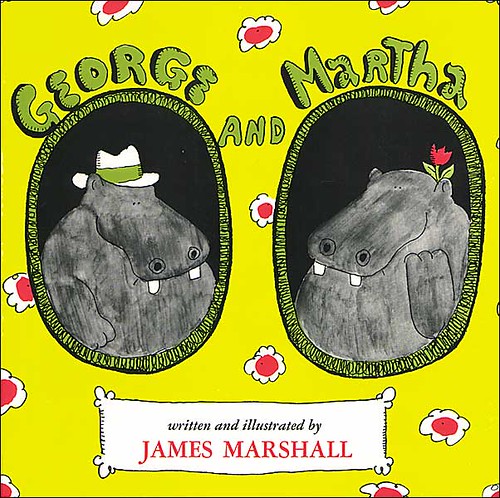
Marshall, J. (1972). George and Martha. Boston, MA : Houghton Mifflin.
Short vignettes depicting the friendship and follies between George and Martha include George's unsuccessful attempt to impress his companion, Martha's insistence that George join her on a picnic, Martha's scientific study of fleas, and George's secret club offer amusement and lighthearted fun in this book by James Marshall.
Marshall's George and Martha books are funny and didactic. While the situations and style of writing are basic, a reader can laugh out loud at the experiences the two share. It is surprising how much these books can lighten one's mood. The book could be useful for a Valentine's Day display for children, reader advisory or storytime because it does a wonderful job of representing friendship between the genders and teaches how friends should treat one another. Adaptations of these short vignettes could also provide fun skits or role-playing for girls and boys.
~ Published Reviews ~
This delightful easy reader offers two humorous stories about hippo friends George and Martha. The succinct first tale about split pea soup shows how friends can work something out even if they are concerned about hurting one another’s feelings. The simple lesson is one to which children can relate. The second story deals with George trying to fly in a hot air balloon but being too heavy for it to lift off. In his attempt to lighten the load, George gets out and the balloon takes off without him. Martha is happy with the outcome knowing that George is safe on the ground with her. Both stories are entertaining and presented in a welcome format that children can read independently. Only a few sentences appear on each text page, while comical illustrations are plentiful and will draw a second look from readers. The illustrations will help readers decipher the text. Add this book to early-grade classroom shelves in order to help children read something fun on their own.
Attebury, N. G. (n.d.) George and Martha. Children's Literature. Retrieved from http://www.childlitassn.org/
George and Martha make a delightful pair in this early reader book, which includes two stories. In “Split Pea Soup,” George just does not have the heart to tell Martha that he dislikes the soup. One day after suffering through his tenth bowl of split pea soup, George pours his soup into his shoes when Martha leaves the room. Unfortunately, Martha is watching him from the kitchen. This funny story has a great moral for children: Friendship requires compromise. In “The Flying Machine” George decides he wants to be the first hippo to fly. There is just one problem: He cannot get the hot air balloon to fly. Not until Martha suggests that George get out of the balloon to make it fly does it actually get airborne. George is disappointed that he will not be able to fly that day, but he quickly recovers once Martha insists that having him with her makes her much happier. Both stories feature unique plots with broad appeal. The picture of George pouring the undesirable split pea soup in his loafers is sure to encourage active responses from children. George and Martha was first published in 1972 and has been a beloved classic ever since.
Hunter, L. M. (n.d.). George and Martha. Children's Literature. Retrieved from http://www.childlitassn.org/
Hunter, L. M. (n.d.). George and Martha. Children's Literature. Retrieved from http://www.childlitassn.org/
_________________________________________________________________________
Module Three
Flotsam

Wiesner, D. (2006). Flotsam. New York, NY: Clarion Books.
A trip to the beach is exciting and full of possibilities for a young person on any day, but not so exciting as finding a strange old camera that washed up in the surf, and developing the pictures to find a whole new world. The camera not only captures, it also compels its captor to memorialize themselves in a kaleidoscope of moments with youngsters by the sea.
Wiesner weaves a surprisingly well-developed and rich story that could only have been hindered by words. The artwork is interesting, with wonderful detail, and every part of the illustrations are aesthetic. This is a terrific book to peruse even without attending to the story because each page is filled with detail. This type of book wonderful for storytime.
~ Published Reviews ~
A wave deposits an old-fashioned contraption at the feet of an inquisitive young beachcomber. Its a Melville underwater camera, and the excited boy quickly develops the film he finds inside. The photos are amazing: a windup fish, with intricate gears and screwed-on panels, appears in a school with its living counterparts; a fully inflated puffer, outfitted as a hot-air balloon, sails above the water; miniature green aliens kowtow to dour-faced sea horses; and more. The last print depicts a girl, holding a photo of a boy, and so on. As the images become smaller, the protagonist views them through his magnifying glass and then his microscope. The chain of children continues back through time, ending with a sepia image of a turn-of-the-20th-century boy waving from a beach. After photographing himself holding the print, the youngster tosses the camera back into the ocean, where it makes its way to its next recipient. This wordless books vivid watercolor paintings have a crisp realism that anchors the elements of fantasy. Shifting perspectives, from close-ups to landscape views, and a layout incorporating broad spreads and boxed sequences, add drama and motion to the storytelling and echo the photographic theme. Filled with inventive details and delightful twists, each snapshot is a tale waiting to be told. Pair this visual adventure with Wiesners other works, Chris Van Allsburgs titles, or Barbara Lehmans The Red Book (Houghton, 2004) for a mind-bending journey of imagination.
Fleishhacker, J. (n.d.). Flotsom. School Library Journal. Retrieved from http://www.schoollibraryjournal.com/
--------------------------------------------------------------------------------------------------------------
Lon Po Po:
A Red-Riding Hood Story from China


Young, E. (1989). Lon Po Po: A Red-riding Hood story from China. New York, NY: Philomel Books.
Three girls left at home alone after their mother goes to visit their grandmother, A.K.A. Lon Po Po are left to contend with the wiles of a tricky wolf who has disguised itself as the old woman. Luckily, the girls are wily themselves and the figure out a way to out-fox the wolf. This beautifully illustrated story that will be familiar to those who know the story of Little Red-Riding Hood and it is no less enjoyable.
The illustrations added tremendously to this story. The story is sufficiently comparable to the other story that without the illustrations, this book would not have stood out. With the illustrations, however, Lon Po Po creates emotions in the reader -- the solitude of the house and the girls as they are at home alone, the anxiety as they stand at the door and the fear as the hungry wolf tries to secure his next meal The method by which the girls save themselves is also more exciting and clever and teaches a lesson about being self-sufficient that Little Red-Riding Hood lacks. Of course, this book is fitting for storytime programs, but it could also be fun for a skit. Reading this story to children along with Little Red-Riding Hood could also prompt a lesson on Chinese culture.
~ Published Reviews ~
Leaving her three children home alone in the country, a woman departs to spend the day with their grandmother Po Po. Although instructed by their mother to latch the door at sunset, the children are persuaded by a wolf disguised as their grandmother to open the door. Chinese panel art is recognizable in the book's overall design and in the layout of the watercolor and pastel art created to illustrate the more than thousand-year-old tale. The wolf symbolizes an ominous side of human nature and appears as either a shadowlike possibility or presence in each double-page spread of this suspenseful book.
Lon Po Po: A Red-riding Hood story from China. (1989). Cooperative Children's Book Center Choices. Retrieved from http://www.education.wisc.edu/ccbc/
This iconographic version of the Caldecott-winning book (Philomel, 1989) translated and illustrated by Ed Young offers a Chinese retelling of the Little Red Riding Hood classic story. Three sisters are left alone overnight while their mother visits grandmother (aka Po Po) on her birthday. Despite her parting words, "Remember to close the door tight at sunset and latch it well," the two younger girls let a wolf disguised as their Po Po into the house. Almost immediately, Shang, the eldest and most clever sister, becomes suspicious and wonders, "Po Po, why is your voice so low?...Why did you blow out the candle?" Yet, due to the innocent enthusiasm of the younger girls, they are soon in bed with the scheming beast. Shang orchestrates their escape, luring the wolf out of the house with the promise of the soft, tender ginkgo nut. The big bad wolf has met his match, confronted with this crafty child, who, with the help of a rope and a basket, finally finishes him off. Young's dramatic, impressionistic pastel-and-watercolor panels seem darker and more menacing against the black background in the film. The bright blues, greens, and oranges provide a striking contrast to the wolf's dark grayish browns. The shadows and cautious, frightened faces coupled with the narrator's expressive storytelling will leave viewers on the edge of their seats.
Lon Po Po: A Red-riding Hood story from China. (2006). School Library Journal. Retrieved from http://www.schoollibraryjournal.com/
_________________________________________________________________________


_________________________________________________________________________
Module Four
Amos Fortune, Free Man

Yates, E. (1951). Amos Fortune, Free Man. New York, NY: Puffin Books.
Amos Fortune was the son of the leader of his people in Africa. His sister was physically limited but beloved. All was well until he and his sister were abducted and forced into slavery. Before his name was Amos, he was separated from his sister and everything that he had known. Despite the harrowing journey and experiences, Amos Fortune persevered, worked out, learned a trade, earned his freedom and worked to free others little by little, proving that he was the leader that he was born to be.
Amos Fortune, Free Man presents a story that differs from more well-known accounts of the life of a slave. Amos Fortune, through hard work, humility and patience, finds the achieves the ultimate dream in his freedom. He doesn't stop there, however. He frees, helps, trains and befriends others. Although the book is directed at children ages 8-12, it could provide a good introduction to slavery and the lives of slaves (although this account is far from typical) for older children as well. This book is perfect for Black History Month. Amos Fortune presents a sort of pre-Civil Rights leadership (especially since the story is set in the pre-Civil War era) that sets the stage for such later figures as Martin Luther King, Jr.
~ Published Reviews ~
In this classic tale of an African prince, stolen from his home, made a slave, and taken to America, it is the character of Amos that drives the story forward. At-mun was the son of the chief and would have been a good leader to his tribe if he had not been taken away to Boston. In Boston, a Quaker named Copeland takes the young man and calls him Amos, and his family teaches Amos to read and write. He acquired the last name of “Fortune” because he was so fortunate not to have been broken the way so many other slaves were, and in comparison to them, he was well-treated. Though Copeland died before freeing Amos, Amos does eventually become a free man. With his freedom, Amos is able to then help others to become free. This is a touching story about one man’s commitment to freedom and how he achieved it.
Foucart, K. (n.d.). Amos Fortune, free man. Children's Literature. Retrieved from http://www.childlitassn.org/
--------------------------------------------------------------------------------------------------------------
Rabbit Hill
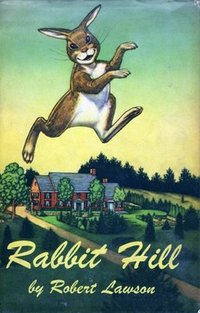
Lawson, R. (1977). Rabbit Hill. New York, NY: Puffin Books.
The animals that live around a vacant house await the new owners. They anticipate the garden that will be planted that will provide food for them to eat. The memorable characters of animals wonder about what kind of people they will be and how they will get along.
This book was surprising socially conscious for one with illustrations that invite very small children. While many children may not pick up on the relevance of some of the things the animals anticipate and wonder about, they can enjoy the different characters and their experience of living day-to-day. This book is an obvious choice for a storytime or a book talk. It can be used to teach about animals, gardening and perhaps even nutrition.
~ Published Reviews ~
There is excitement in the air when the animals hear that new people will be moving into the big house. It has been empty for some time and there has been no one to plant a garden. Without the garden many of the animals are having trouble finding food. In this classic award winning story the characters will warm the hearts of readers as the different animals share stories about life on Rabbit Hill. They talk about the good people and those who were “mean, shiftless and inconsiderate.” Curiosity is rampant as the animals wonder what kind of people will be living in the house. Will they be kind and good people, will they bring a dog, and will they have a garden? When the big day arrives and moving vans come up the driveway, all of the animals are there for the big occasion. The reader can feel the animals holding their breath as the car with the new owners pulls in; the ageless illustrations provide this same suspense. Young readers will be delighted with these whimsical characters as they go about their daily lives, learning more about the new people who will have such an impact on the animals’ lives. From Little Georgie Rabbit and Willie Fieldmouse, to pessimistic Uncle Analdas, the animals learn to trust the new people as adventure after adventure follows. 2007, Puffin Books, $5.99. Ages 8 to 12.
Williamson, N. (n.d.). Rabbit hill. Children's Literature. Retrieved from http://www.childlitassn.org/
_________________________________________________________________________
Module Five
Ellington was not a Street

Shange, N. (2004). Ellington was not a street. New York, NY: Simon & Schuster Books for Young Readers.
Ellington is more than just a street. Each page reveals more about who Duke Ellington was to his daughter and to the world. Shange shows Ellington to be a musical leader, a political figure and an international ambassador who opened his doors to noteworthy figures of the times.
This book offers an introduction into a figure whose life could cover pages and pages. Telling the story from the point of view of Ellington's daughter makes it easier for children to grasp, since the story ultimately tells how Duke Ellington is naturally much more than a name to the little girl that he raised. In addition to Duke Ellington, Shange identifies other important figures of the time of whom many children have never heard. Through the eyes of the little girl, they are just the friends of her father. The illustrations are warm and inviting as well as visually captivating. The colors and the style will both lead children to want to explore. This book would work well to introduce children to important figures of the past via a storytime or other program.
~ Published Reviews ~
The text of this picture book for older children is a paean to Shange's family home and the exciting men who gathered there, everyone from W. E. B. DuBois and Paul Robeson to Dizzy Gillispie and Duke Ellington. Taken from Shange's 1983 poem "Mood Indigo," the words here recall, from a child's perspective, what it was like to listen "in the company of men / politics as necessary as collards / music even in our dreams." The evocative words are more than matched by Nelson's thrilling, oversize oil paintings, a cross between family photo album and stage set, featuring this group of extraordinary men interacting--playing cards, singing, discussing. The girl who is always watching them is, unfortunately, portrayed as very young, perhaps three or four, although she appears somewhat older on the beguiling jacket art. Preschoolers are not the audience for this, and despite the helpful notes that introduce the men mentioned in the poem, even older children will need further explanations (e.g., where are the famous women?). Depicting the narrator as a child closer in age to the target audience would have helped bridge the gap between a poem written for adults and a book for children. Still, with words and pictures that are so enticing, this will be embraced by many.
Cooper, I. (2004). Ellington was not a street. Booklist, 100(12). Retrieved from http://www.booklistonline.com/
Deeply colored paintings enrich this homage to African-American men who made history and influenced culture, including Duke Ellington, Paul Robeson, Dizzy Gillespie, and W.E.B. DuBois. Nelson's setting is a home, filled with the folks who made it happen, as observed by a small girl whose presence, greeting the guests or peeking around the corners, adds the child's point of view. The poetic text is spare, with only a few words on each spread, but they match the majesty of the scene. Children will need context to understand the brief lines, and happily, an author's note provides it. In bell hooks style, none of the lines or names are capitalized, nor do they have punctuation. Intended for children today who know these names as commemorative plaques on buildings or streets, the deceptively simple text reveals the feel of the Harlem Renaissance: "Politics as necessary as collards, music even in our dreams." A tribute to what these men did for African-Americans, indeed all Americans, is soulfully and succinctly stated: "Our doors opened like our daddy's arms, held us safe and loved." Exquisite.
Ellington was not a street. (2003). Kirkus Reviews, 71(22). Retrieved from http://www.kirkusreviews.com/
--------------------------------------------------------------------------------------------------------------
Esperanza Rising
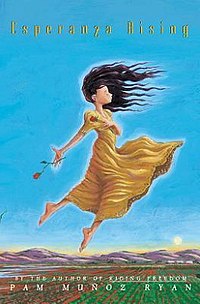
Munoz Ryan, P. (2000). Esperanza rising. New York, NY: Scholastic Press.
In an unfortunate turn of events, Esperanza goes from riches to rags. She and her mother must flee their Mexican town with their extensive lands and prosperity to the United States along with their hired help. Esperanza slowly learns through hardships and close calls that she can work as hard as anyone to achieve what she wants.
Esperanza Rising brings together issues of immigration, employment rights, discrimination and culture in a realistic historical context as well as everyday matters like perseverance, determination, hard work and humility. There are many lessons to be learned in this book. Particularly useful are the descriptions of some aspects of life in Mexico and the United states in the 1930's. This book would serve as an excellent book to display or discuss during Mexican Heritage Month, but has relevance for young people of varying ages of many ethnic backgrounds.
~ Published Reviews ~
Moving from a Mexican ranch to the company labor camps of California, Ryan's lyrical novel manages the contradictory: a story of migration and movement deeply rooted in the earth. When 14-year-old Esperanza's father is killed, she and her mother must emigrate to the U.S., where a family of former ranch workers has helped them find jobs in the agricultural labor camps. Coming from such privilege, Esperanza is ill prepared for the hard work and difficult conditions she now faces. She quickly learns household chores, though, and when her mother falls ill, she works packing produce until she makes enough money to bring her beloved abuelita to the U.S.. Set during the Great Depression, the story weaves cultural, economic, and political unrest into Esperanza's poignant tale of growing up: she witnesses strikes, government sweeps, and deep injustice while finding strength and love in her family and romance with a childhood friend. The symbolism is heavy-handed, as when Esperanza ominously pricks her finger on a rose thorne just before her father is killed. But Ryan writes movingly in clear, poetic language that children will sink into, and the books offers excellent opportunities for discussion and curriculum support.
Eugberg, G. (2000). Esperanza rising. Booklist, 97(7). Retrieved from http://www.booklist.com/
The author of "Amelia and Eleanor Go for a Ride "(1999) and "Riding Freedom "(1997) again approaches historical fiction, this time using her own grandmother as source material. In 1930, Esperanza lives a privileged life on a ranch in Aguascalientes, Mexico. But when her father dies, the post-Revolutionary culture and politics force her to leave with her mother for California. Now they are indebted to the family who previously worked for them, for securing them work on a farm in the San Joaquin valley. Esperanza balks at her new situation, but eventually becomes as accustomed to it as she was in her previous home, and comes to realize that she is still relatively privileged to be on a year-round farm with a strong community. She sees migrant workers forced from their jobs by families arriving from the Dust Bowl, and camps of strikers--many of them US citizens--deported in the "voluntary repatriation" that sent at least 450,000 Mexicans and Mexican-Americans back to Mexico in the early 1930s. Ryan's narrative has an epic tone, characters that develop little and predictably, and a romantic patina that often undercuts the harshness of her story. But her style is engaging, her characters appealing, and her story is one that--though a deep-rooted part of the history of California, the Depression, and thus the nation--is little heard in children's fiction. It bears telling to a wider audience.
Esperanza rising (2000). Kirkus Reviews, 68(19). Retrieved from http://www.kirkusreviews.com/
_________________________________________________________________________
Module Six
Scaredy Squirrel at the Beach

Watt, M. (2008). Scaredy Squirrel at the beach. Toronto: Kids Can Press.
Scaredy Squirrel is afraid of everything and yet he wants to go to the beach. The best and least "scaredy" beach is the one that he makes for himself, but he needs a seashell to complete the scene. Thus, he must go to the beach. He creates a complete plan and itinerary to get the most out of his trip while limiting his contact with those things that scare him. Eventually, Scaredy Squirrel realizes that the real beach isn't so bad.
This book will capture and hold the attention of most any youngster from ages 5-10. The concept of a scared squirrel is funny and Watt maintains the humor with her whimsical writing and her comic sense. The subject of this book alone is amusing -- a squirrel at the beach. It is the illustrations that are attention-grabbing. There is a great deal of detail and interesting tidbits to look at like Scaredy Squirrel's itinerary. This book is full of laughs and it is good if it is presented in a way that the child can really take time to look closely at the pages. This book could be used to segue into a craft, especially since the book begins with Scaredy's own beach craft project.
~ Published Reviews ~
That worrywart Scaredy Squirrel (2006) returns in another hilarious tale, this time contemplating a beach vacation. Concerned about falling coconuts, seagulls, and lobsters, however, he decides to build his own beach. After a burst of squirrel creativity, he is soon lounging on a bed of kitty litter, soaking in sun from a flashlight, and contemplating the water in his inflatable pool. Unfortunately, there’s something amiss, which puts Scaredy on course to a real beach to acquire a seashell. As might be expected, his preparations for the visit involve much more than just packing a suit. In fact, the only thing that slips beneath his radar are people—who eventually win him over and also inspire a funny addition to his own sunbather’s haven. In appealing, flat colors, Watt’s cartoon-style pictures (full spread and graphic-novel-style panels) add joke after joke. With simple shapes bordered in distinctive ribbons of black and white, they deliver a surprise on every page as the obsessive squirrel, with toothy grin and boundless imagination, scampers around, trying to anticipate everything that can go wrong.
Zvirin, S. (2008). Scaredy Squirrel at the beach. Booklist, 104(19). Retrieved from http://www.booklist.com/
In Scaredy Squirrel at the Beach, Mélanie Watt continues the adventures of Scaredy Squirrel found in her two previous picture books, Scaredy Squirrel and Scaredy Squirrel Makes a Friend. Scaredy Squirrel is a character who fears everything outside his tree home. He is afraid to go to the beach because of his fear of seagulls, jellyfish, falling coconuts and pirates. Because of his fears, he builds his own beach out of his household materials like an inflatable swimming pool while using cat litter for sand. When he discovers that he needs an actual seashell from the actual beach and must travel there to get one, he discovers that his fears were unfounded and that the outside world is a friendly, fun place. Mélanie Watt tells her stories using clever full page illustrations which include checklists, signs, a squirrel passport large enough to read and a diagram showing what Scaredy wears to the beach to keep safe. Some pages are divided into four sections to show the passage of time, and other pictures take up an entire two pages, with text confined to the important story action, even as other, interesting things are happening in the very detailed pictures. Young children will enjoy this book as a read aloud, and older children will enjoy the humour as they will identify with Scaredy's fears and ability to overcome them.
Groberman, R. (2008). Scaredy Squirrel at the beach. CM Magazine, 14(19). Retrieved from http://www.umanitoba.ca.cm/
_________________________________________________________________________
Module Seven
Tangerine

Bloor, E. (1997). Tangerine. San Diego, CA: Harcourt Brace.
Paul Fisher wears severely thick glasses because he stared too long at the sun -- or so he has been told. Paul's whole family revolves around his brother, Erik, the football star. His parents barely pay attention to the fact that Paul is a great soccer goalie. They even move to Florida in an attempt to launch Erik's high school football stardom and secure him a college scholarship. After a calamity shakes up Paul's school situation, he switches to school full of lower income students and joins the soccer team. Paul is confronted with many truths and perspectives that differ from what he knew before.
Tangerine is a maze of a book. Bloor's first chapters give very little hint of just where the book is going but the ominous first pages keep the reader searching for the connection. This book has been described as applying some elements of classic gothic novels, but there is also a realistic sense of the mundane life of a dis-preferred child. The story picks up after a while, and it becomes clear how many disparate details are coming together to resolve the fear and apprehension that Paul experienced early within the book. This book is not straightforward and really requires the reader to stick with it until the momentum builds up. The various elements of the book like the suspense, Paul's fight to be considered normal, his friendship with the kids from the other part of town, football, soccer, strange and untimely death and outer image vs. inner reality provide enough entry points to capture young readers that a wide variety of children can enjoy this book. This book could hook young people in teen book clubs.
~ Published Reviews ~
Although Paul needs thick glasses to enable him to see well enough to do things other kids do, his instinctual vision isn't impaired. It's 20/20, allowing him to "see" behind the facade of Tangerine County, Florida, where his family has recently moved. He chronicles his adjustment to this bizarre new place, describing his triumph at soccer, making new friends, and tending a tangerine grove. He also unravels the horrible truth about his disturbed, menacing older brother. There's a lot going on in the story--perhaps too much--and with the exception of Paul, the characters are little more than intriguing, shadowy shapes. Paul's musings occasionally seem too old for his years, as well. Still, the book has a lot going for it, especially the atmospheric portrait of the eerie community, where lightning strikes more often than it does anywhere else and a school is swallowed by a sinkhole. One thing is for sure: this dark debut novel proves that Bloor is a writer to watch.
Squires, K. (1997). Tangerine. Booklist, 93(18). Retrieved from http://www.booklist.com/
When Paul Fisher and his family move to Tangerine County, Florida, his life changes dramatically. Paul has lived his twelve years in the shadow of his football-playing brother, Erik. The boys' father seems to be reliving his life through Erik, steadily building the "Erik Fisher Football Dream." Unlike Erik, Paul is considered a geek by some of his classmates. He wears thick glasses to protect his eyes that were damaged when, at five years old, he looked at a solar eclipse without protective eyewear. Or so his parents and his brother have told him. Paul resists being labeled "legally blind" because he really can see. In fact, he sees more than his parents realize. Tangerine County is full of surprises. Underground fires cause Paul's neighborhood to smell of smoke and burnt rubber, and the residents accept the daily and dangerous thunderstorms as just a part of life. When a sink hole swallows the portable school buildings at Lake Windsor Middle School, Paul transfers to Tangerine Middle School, which is old and shabby--very different from Lake Windsor. He is determined to play goalie for the soccer team, but first he has to overcome his fear of the tough team captain, Victor. He also has to win the respect of the team, which includes girls, some of whom can play better than any players he has seen before. Paul gains self-confidence and makes new friends, but his loyalty to them is tested by Erik's menacing behavior. Erik's actions trigger haunting and vague memories that Paul cannot quite comprehend. This is an exciting, suspenseful, and thought-provoking book that should be a hit with soccer-playing middle schoolers.
Moses-Allen, B. (1997). Tangerine. VOYA, 20(3). Retrieved from http://www.voya.com/
--------------------------------------------------------------------------------------------------------------
A Mango-shaped Space

Mass, W. (2003). A mango-shaped space: A novel. New York, NY: Little, Brown.
Read about Mia's journey as she comes to a better understanding of her synesthesia, a condition enables her to see color in concert with words, numbers and even bubbles. Mia finds it harder to relate to the non-synesthetes in her life and moves closer to a synesthete boy that she has met online. As her grades start slipping and her best friend begins feeling alienated -- even Mia's cat Mango, the reincarnated form of her deceased grandfather (or so she thinks) is neglected from time to time -- Mia struggles to reconcile everything in her life.
A Mango-shaped Space manages to capture the spirit of being the odd person out as a young teen while portraying an actual condition that has been identified in a growing number of people. In this case, the protagonist is able to take an almost haughty position, as if those without synesthesia are not worth her time. This gives a different view than some books, though the result is the same for Mia -- she alienates herself more and more, finds that her relationships are breaking down and that she loses one that is very close to her. There is a subtle message in this book about balance that some young people may miss outright while reading this book but that may hit them later. The book also provides a bibliography and links to websites about synthesthesia. This is a worthwhile book to discuss and so would work well for any kind of discussion group of book club.
~ Published Reviews ~
This contemporary novel does for synesthesia what Terry Hesser's Kissing Doorknobs (1998) does for obsessive-compulsive disorder: the lively personal story demystifies a fascinating condition. For 13-year-old Mia Winchell, the world has always been filled with a wonderful, if sometimes dizzying, sensory onslaught--numbers, letters, words, and sounds all cause her to see a distinct array of colors. She keeps her unusual condition a secret until eighth grade, but then her color visions make math and Spanish impossibly confusing, and she must go to her parents and a doctor for help. However, this is more than a docu-novel. Mass beautifully integrates information about synesthesia with Mia's coming-of-age story, which includes her break with her best friend, her grief over her grandfather's death, and the loss of her beloved pet. The episode where Mia fabricates an illness to try out acupuncture for the color visions it produces is marvelously done, showing Mia's eagerness for new experiences even as it describes a synesthete's vision. References to a comprehensive Web site and bibliography about synesthesia are included.
Carton, D. (2003). A mango-shaped space. Booklist, 99(15). Retrieved from http://www.booklist.com/
A young teen whose world is filled with colors and shapes that no one else sees copes with the universal and competing drives to be unique and to be utterly and totally normal. Thirteen-year-old Mia is a synesthete: her brain connects her visual and auditory systems so that when she hears, or thinks about, sounds and words, they carry with them associated colors and shapes that fill the air about her. This is a boon in many ways-she excels in history because she can remember dates by their colors-and a curse. Ever since she realized her difference, she has concealed her ability, until algebra defeats her: "Normally an x is a shiny maroon color, like a ripe cherry. But here an x has to stand for an unknown number. But I can't make myself assign the x any other color than maroon, and there are no maroon-colored numbers. . . . I'm lost in shades of gray and want to scream in frustration." When Mia learns that she is not alone, she begins to explore the lore and community of synesthesia, a process that disrupts her relationships with her family, friends, and even herself. In her fiction debut for children, Mass has created a memorable protagonist whose colors enhance but do not define her dreamily artistic character. The present-tense narration lends immediacy and impact to Mia's color perceptions: "Each high-pitched meow sends Sunkist-orange coils dancing in front of me. . . . " The narrative, however, is rather overfull of details-a crazily built house, highly idiosyncratic family members, two boy interests, a beloved sick cat-which tend to compete for the reader's attention in much the same way as Mia's colors. This flaw (not unusual with first novels) aside, here is a quietly unusual and promising offering.
A mango-shaped space. (2003). Kirkus Reviews, 71(5). Retrieved from http://www.kirkusreviews.com/
View an original book trailer for this book below.
_________________________________________________________________________
Module Eight
Inkheart
Funke, C. (2003). Inkheart. Frome, Somerset (England): The Chicken House.
Meggie is the daughter of a master bookbinder. They have led a non-traditional life that grows more peculiar with the arrival of Dustfinger, a shady character whose warnings to Meggie's father, Mo, causes him to pack leave for a visit to Meggie's relative. Elinor Loradon is a book collector who shelters them and is taken by a special book that Mo is protecting called Inkheart. When Mo is abducted, it is up to them to save him. This is only the beginning. Meggie learns that Mo is called Silvertongue and that he has the ability to read characters from books into real life, which makes him very important to Capricorn, who calls himself the devil. Inkheart is a winding ride across Europe with various twists and turns and is the first in a series of books involving these characters.
Inkheart allows the imagination to run wild and seriously considers the thought that most everyone has had: what if a fictional book/television/video game character were real? What if I could bring that character to life? This book is an affirmation to young people that it is okay to daydream and to be creative and imagine the furthest reaches of possibility. The book is rather long -- longer than seemed necessary given the story but the extra pages weren't wasted. The length will not be a problem for book-lovers but may challenge youths that are not strong readers. Some of the characters have quite a strong edge and Funke does not back away from violence but older readers will enjoy this book and will probably want to go on to read the subsequent books Inkspell and Inkdeath. This is a great book to use in encouraging young people to write and create their own characters that they would like to bring to life.
~ Published Reviews ~
It is hard to avoid preciosity in books about books, but here Funke pulls off the feat with vigor. Meggie, an avid reader, lives alone with her father, a bookbinder; her mother disappeared years before. When a disturbing stranger named Dustfingers intrudes on their peace, she gradually discovers that the barrier between books and the real world is permeable and that an ill-fated read-aloud years ago unleashed Capricorn, who "would feed [a] bird to [a] cat on purpose . . . and the little creature's screeching and struggling would be as sweet as honey to him." Funke takes her time with her tale, investing her situations with palpable menace and limning her characters with acute sensitivity; she creates in Meggie a stalwart heroine who never loses her childish nature even as she works to contain the monster and bring her mother back. Master translator Bell takes the German text and spins out of it vivid images and heart-stopping language that impel the reader through this adventure about narratives-a true feast for anyone who has ever been lost in a book.
Inkheart. (2003). Kirkus Reviews, 71(18). Retrieved from http://www.kirkusreviews.com/
Inkheart is another wonderful tale of adventure and intrigue translated from the German author Cornelia Funke. Each chapter begins with an excerpt from a "great" piece of literature. The influence of all of these fantasy (and fantastic) authors has obviously greatly influenced Funke's writing style. The quotes widely range in authors and styles: from The Jungle Book by Kipling to The Lord of the Rings by Tolkien. This book is well written, and the beautiful imagery draws the reader further and further into the story. As a translation, this book stands up to most stories written in an author's first language. The story unfolds slowly giving away only bits and pieces of the puzzle which frustrates not only the main character, Meggie, but the reader as well. The plot revolves around the "actual" book Inkheart which influenced Meggie's past, more than she realizes at first, and then finds it greatly affecting her present and future. Meggie's father, Mortimer (Mo), is a bookbinder, and her Aunt Elinor is a overzealous book collector; these adults in the story are no more sensible than Meggie when it comes to decision making. We seem to jump into this story mid stream, which leaves the reader trying untangle all the information as it is presented to Meggie. Other important supporting characters belong to (or in) Inkheart and have been magically brought into "our" world. These characters create the conflict which Mo and Meggie ultimately need to resolve. There were parts of this novel where the plot dragged and the action seemed unnecessary for moving the story ahead. At times, the main characters plotted or planned but didn't follow through. They seemed to let the plot lead them and appeared to go along with whatever came next. Characterization in this novel lacked real depth. An attachment to any particular character was not solidified. The missing connections did not make me want to read more about Meggie, Mo, or Capricorn. The descriptions of Mo's talent were random and illogical throughout. People appearing and disappearing wasn't clearly addressed. Was there supposed to be an alternative or parallel reality? Unfortunately, the antagonistic character of Capricorn was very flat and needed far more detail to create a believable horrifying villain. The author mainly developed Capricorn through what other characters said. When Capricorn was in the "action," he seemed to shout and bluster but didn't seem powerful or evil. Even the desecration of Aunt Elinor's books was achieved in absence of both the reader and Capricorn! It also must be mentioned that the format, cover and illustrations on and within this book play a huge part in creating the aura surrounding the mystery of the plot. The book cover is subtly textured and appears to be luxuriously bound. The images shimmer and leap out to one's sense of touch. The "nutmeg" smell of the pages is referred to in the novel and literally makes the reader stick their nose in the book! The conclusion is artfully woven, although it is, again, mainly plot driven. The reader is left wondering about the reality of this tale in spite of the trolls, blue fairies, and Tinker Bell. Inkheart will appeal to all young adults. However, the size of this novel may be off putting for weaker readers. Any avid reader should definitely add this to their must read list! As an adult, I found the connections to the excerpts from other novels especially fascinating. I certainly will wonder next time I read a book aloud!
Bernard, G. (2004). Inkheart. CM Magazine, 10(11). Retrieved from http://www.umanitoba.ca.cm/
View an original book trailer for this book below.
_________________________________________________________________________
Module Nine
The Body of Christopher Creed

Plum-Ucci, Carol. (2000). The body of Christopher Creed. San Diego, CA: Hyperion.
Torey Adams has become obsessed with finding Chris Creed, the strange guy from his high school that disappears one day. Chris Creed left a note, leading many to assume that he has taken his own life. In this note, he names people that he wished he could have been like, including Torey. This creates the germ in Torey's mind that leads to one mystery after another and prompts Torey to witness his own life from a different angle. All of his money and privilege, his relationships, everything that he thought about the people around him, especially the 'Boons' whom people like him would never befriend start to shine through a different filter as he learns more about who he is and the society in which he lives. The mystery only leads to dramatic and unexpected ending that leads Torey to desperately seek the truth about Chris Creed.
This book is more than a mystery. Plum-Ucci examines the life as a typical teenager knows it from image to privilege to familial relationships to the divide between the haves and the have-nots. An adult reader may flashback to their own youth and the various high school experiences that led them to their current circumstances. It is only a hope, perhaps, the youths will have a similar flash foward to where they want to be in the years to come. Nevertheless, following the mystery from beginning to end leads to realizations and insights worthy of any reader. The pacing of the book is appropriate. There are more than enough turns in the plot to engage readers. This book is perfect for discussion but is also nice for encouraging writing à la creed.doc.
~ Published Reviews ~
Chris Creed, a high school junior and all-around "town weirdo," envies the popular kids in school like Torey Adams: "I don't understand why I get nothing and these boys get everything--athletic ability, good personalities, beautiful girlfriends," he writes in an enigmatic e-mail to the high school principal. He goes on to say, "I wish no malice on anyone. I only wish to be gone." And indeed, he vanishes. His parents are distraught, and the school community is in turmoil. No one liked Chris particularly, but no one wanted him dead or gone--or did they? Sixteen-year-old Torey's previously "perfect" life is turned upside down in the wake of Chris's disappearance, as he starts to formulate questions about the people around him, begins to fight peer pressure, and learns to appreciate previously unseen qualities in some of the kids from the other side of the tracks. Torey even starts to doubt his own sanity when he has a vision and stumbles across a dead body. The secrets of a small town slowly emerge in this suspenseful and well-told coming-of-age story, as Torey comes to understand something of the complexities of life. The mystery of Chris's disappearance and the intriguing characters here will pull readers in; this is a gripping tale, with realistic, sometimes profane dialogue. An exceptionally strong first novel, by an author worth watching.
Rohrlick, P. (2004). The body of Christopher Creed. KLIATT Review, 34(4). Retrieved from http://www.encyclopedia.com/Kliatt/publications.aspx?pageNumber=1
Torey Adams, golden boy, harassed Christopher Creed as much as anyone else in their high-school class; Creed, a social misfit and irritating to boot, seemed to invite abuse. After sending a (possible) suicide email note to the high school principal, Creed disappears; when he fails to reappear or be found, rumors of homicide in the woods begin to fly. There is no body or indication of foul play, but that doesn’t stop Mrs. Creed--she is bound and determined someone will be punished for what happened to her oldest son. Her malevolent eye falls on Bo Richardson, an apparent hoodlum from the wrong side of the tracks, and for a time it looks as if she’s going to succeed in railroading him into jail. Torey and friend Ali (now Bo’s girlfriend) attempt to clear Bo, but their efforts do little more than add to the appearance of guilt. Plum-Ucci limns the social hierarchy of a community resistant to both change and truth, and her control is evident in the unsensational handling of what could easily have degenerated into a lurid slice of small-town life. Torey’s discovery of a body in the woods is a devastating moment, but even more devastating is his realization of some unpleasant realities about adults with feet of clay. This is a complex, credible look at alienation, compassion, loyalty, and cruelty among young and other adults.
Del Negro, J. M. (2000). The body of Christopher Creed. The Bulletin of the Center for Children's Books, 53(8). Retrieved from http://bccb.lis.illinois.edu/
_________________________________________________________________________
Module Ten
What I Saw and How I Lied
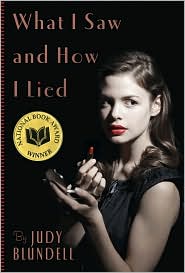
Blundell, J. (2008). What I saw and how I lied. New York, NY: Scholastic Press.
A trip to Palm Beach changes Evie's life. After her stepfather suddenly insists on taking Evie and her mother to Florida, away from his mother's house, Evie gets to feel special and different. An embarrassing experience at a local dance results in Evie meeting a handsome and dashing young man, for whom she immediately falls. Soon, Evie, her mother, and Peter are going everywhere and having a wonderful time. Evie's stepfather, meanwhile, is working diligently to secure deals for himself with a wealthy couple they meet in their hotel. It isn't long before things start to fall apart, culminating in Peter's mysterious death while sailing with Evie's mother and stepfather. Startling revelations finally lead Evie to take surprising action in order to get what she wants.
This may be a contemporary classic for teaching the lesson of "be careful what you wish for." Many girls will relate to Evie's desire to grow up and to her mother's insistence that she enjoy her childhood rather than rushing into womanhood. Blundell wound the story up slowly but ground the characters and developed them before the story began to take off. The characters are almost contrived types, the wiseguy stepfather, the bombshell mother, the handsome but dark young veteran, the wealthy acquaintances, the daughter on the edge of innocence. Blundell does flesh the characters out, however. It is surprising to see how far Blundell pushes her characters in their endeavors to get what they want, especially Evie, who seems to realize in the end what she'd been told all along and yet makes very adult decisions. This may be a hard read for all but voracious readers because of the post-World War II setting. Girls will likely be pulled deeper into the story by Evie's relationship with her crush, Peter. This book can be added to book lists related to World War II since the book gives a good glimpse of everyday life for a young person during that period. It is also good for thinking about justice and inequality.
~ Published Reviews ~
Judy Blundell creates a fast-paced, suspenseful look at the after-effects of World War II through the eyes of fifteen-year-old, wanna-be-eighteen, Evie. The war has ended; Evie’s stepfather has returned home safely and takes Evie and her mother on an unexpected trip to Palm Beach, Fla. Evie falls in love with movie-star-handsome Peter, only to discover herself caught in a web of lies spun by her family. Suddenly, the protected and innocent teen stands to lose everything she holds dear, and anti-Jewish sentiments of the war become personal issues. Blundell deftly fashions Evie as an innocent but glamour-struck post-war teen who must almost instantly develop the integrity and self-reliance to make impossibly tough judgments. Evie is fascinatingly multifaceted as she approaches adulthood in ways she--and readers--never anticipated.
Beemer, J. (2008). What I saw and how I lied. ALAN Review, 36(1). Retrieved from http://www.alan-ya.org/
World War II is over; fifteen-year-old Evie’s stepfather, Joe Spooner, is home; and with several of his newly opened appliance stores busily supplying returning GIs with a post-rationing glut of consumer goods, Joe has announced a spontaneous trip to Palm Beach, Florida for Evie and her mother. Palm Beach isn’t quite what Evie expected. It’s a ghost town in autumn, and their hotel—one of the very few even open before the winter season—has few residents. Fellow guests the Graysons seem like a friendly enough couple, decent dinner companions who propose an entrepreneurial venture with Joe; another visitor, Peter Coleridge, a young veteran who knew Joe before they returned from Austria, quickly becomes the object of Evie’s infatuation. Evie is so thoroughly smitten that she fails to interpret the half-heard conversations of the adults around her or to question carefully the increasingly odd behavior of her parents. Eventually, though, even a lovestruck teen can’t ignore the explosion of tensions in their tiny, closed community—the Graysons are Jewish and unable to transact any business at all in restricted Palm Beach; Peter is blackmailing Joe for his share of illegally obtained treasure confiscated by the Nazis from their Jewish victims; Mom has been slipping out with Peter on the sly. When Peter is found dead after a boating excursion with Joe and his wife, suspicion falls squarely on Evie’s parents, and it’s the testimony of the betrayed teen at the inquest that will determine their futures. Blundell crafts a richly atmospheric period piece, reminiscent of the films that intrigue adolescent Evie, movies about worldly wise dames played by Joan Crawford or Barbara Stanwyck. The girl’s heartbreaking coming-of-age tale rings true as she brazenly joins the world of adult deception and lies yet manages ultimately to pull off her own small but significant stand for social justice.
Bush, E. (2008). What I saw and how I lied. The Bulletin of the Center for Children's Books, 62(4). Retrieved from http://bccb.lis.illinois.edu/
_________________________________________________________________________
Module Eleven
Blizzard! The Storm that Changed America

Murphy, J. (2000). Blizzard! The storm that changed America. New York, NY: Scholastic Press.
The blizzard of 1888 was unlike any the United States had seen before or since. Through a series of accounts of the experiences of various people, this book creates a rich tapestry of what is was like to live through the blizzard that changed America. He tells of those who had to continue to go to work despite the dangerous conditions, of several who didn't make it out alive, of those whose luck in some situations enabled them to live to talk about their experiences later.
Murphy created an interesting account of a true event using the words of people who lived through it. Reading about the wide variety of occurrences, from comical to tragic, brought a real sense of how frightful and amazing the experience must have been. This is not a subject that would generally be of interest to most intermediate students but Murphy's style of writing and presentation goes a long way. Readers will definitely come away with a sense of life around the turn of the century and of the overwhelming power of nature. This is a good addition to book displays during winter months, especially in areas where snow is scarce.
~ Published Reviews ~
In the same format as his Newbery Honor title "The Great Fire "(1995), Murphy brings the blizzard of 1888 to life. He shows how military weather-monitoring practices, housing and employment conditions, and politics regarding waste management, transportation monopolies, and utilities regulation, all contributed to--and were subsequently affected by--the disaster. He does so through an appealing narrative, making use of first-hand accounts whose sources he describes in his notes at the end (though, disappointingly he cites nothing directly in the text). The wealth of quotable material made available through the letters of members of "the Society of Blizzard Men and Blizzard Ladies" and other sources help to make the story vivid. Many drawings and photographs (some of the blizzard, but most of related scenes) illustrate the text. These large reproductions are all in a sepia-tone that matches the color of the typeface--an effect that feels over-the-top, but doesn't detract significantly from the power of the story. Murphy's ability to pull in details that lend context allows him to tell this story of a place in time through the lens of a single, dramatic episode that will engage readers. This is skillfully done: humorous, jaw-dropping, thought-provoking, and chilling.
Blizzard! The storm that changed America. (2000). Kirkus Reviews, 68(22). Retrieved from http://www.kirkusreviews.com
Murphy turns his attention from fire (The Great Fire, BCCB 5/95) to ice with this riveting account of the storm system that paralyzed much of the Eastern seaboard in March of 1888. In a masterful piece of storytelling, Murphy regales readers with tales of the fortitude and foolhardiness of citizens who matched wills with the blizzard. Ex-senator Conkling boasts of his stamina as he forces his way through the winds and drifts, only to succumb to weather-related complications within a month. A farm wife shelters stranded travelers but can only feed them a dinner of frozen sparrows plucked from the yard. A divinity student is trapped on a snowbound train, and a reporter spends seasick days tossed by the waves in a harbor pilot boat. This title goes well beyond gripping narrative, however, to demonstrate how the storm exposed the weakest seams in the nineteenth-century urban fabric--utility companies that ignored ordinances for buried cable; corrupt city politics that stalled efforts to introduce underground rail service; inadequate housing for masses of immigrants; a laissez-faire attitude toward snow removal and sanitation. If sepia-toned period photos and engravings of the buried cities and environs fail to set viewers’ teeth chattering, Murphy’s reminder of snowfalls (as recent as January 2000) that continue to cripple the coast will: “No matter how many pieces of equipment we develop, no matter how many ways we try to predict weather patterns, nature always has the potential to surprise and overwhelm us.”
Bush, E. (2008). Blizzard! The storm that changed America. The Bulletin of the Center for Children's Books, 54(5). Retrieved from http://bccb.lis.illinois.edu/
_______________________________________________________________________
Module Twelve
The Voice that Challenged a Nation:
Marian Anderson and the struggle for equal rights

Freedman, R. (2004). The voice that challenged a nation: Marian Anderson and the struggle for equal rights. New York, NY: Clarion Books.
Freedman conveys the life of vocal virtuoso Marian Anderson and her impact on the Civil Rights Movement. From her youth, Anderson was a gifted singer and would have been professional by today's standards long before high school. Anderson confronted a number of challenges and overcame nearly all of them. Although one challenge, racial prejudice, was a particularly difficult and insidious one to hurdle, Marian used her influence and fame to contribute to the movement toward equal rights.
It may be that not many youths know the name of Marian Anderson now. This book is unlikely to be of interest to many readers who are not interested in the Civil Rights Movement or are not specifically looking for biographical information on the singer. There are many children who could benefit from reading this book, however, including young singers who could learn from Anderson's commitment to excellence and vocal training. Freedman really does well at presenting a full picture of Anderson's life and affect on the world. It would be wonderful if a school library, for example, could tie this book into musical arts/choir curriculum somehow. This is another book that should be highlighted during Black History Month.
~ Published Reviews ~
Freedman offers the story of a movement encapsulated in the biography of an extraordinary African-American woman. Born poor, Anderson grew up with her sisters in a strong family led by her indomitable mother. Her extraordinary voice was discovered at an early age, and her joy in singing led her to church and community events, where "the baby contralto" would earn "twenty-five or even fifty cents" for singing a song. Anderson's early discipline and determination saw her through years of hard work performing and honing her craft. When she was a teenager she made singing appearances for five dollars apiece, and she turned most of the money over to her mother and sisters. The Union Baptist Church (where Anderson sang in the choir) and the black community where she grew up supported her throughout her career: by raising money to buy her first evening gown, to send her to high school, and to pay for the singing lessons that would ultimately catapult her into the international limelight. While Anderson's joy of singing occupies center stage, her growth as a performer is set against the backdrop of invasive Jim Crow laws and the growing Civil Rights Movement. The climax of this biography--and possibly of Anderson's life--is her performance at the Lincoln Memorial in 1939, after she was banned from Constitution Hall by the Daughters of the American Revolution. Freedman tells the story of this extraordinary woman in vivid language enlivened by quotes from Anderson herself. Black-and-white photographs throughout give a sense of the changing times in which Anderson lived and gently remind readers that it was not so long ago. This will satisfy those readers whose curiosity was piqued by Ryan's picture book biography When Marian Sang (BCCB 12/02). Chapter notes, a discography, and a selected bibliography are included; the bound book will contain an index.
Del Negro, J. M. (2004). The voice that challenged a nation: Marian Anderson and the struggle for equal rights. The Bulletin of the Center for Children's Books, 57(11). Retrieved from http://bccb.lis.illinois.edu/
_________________________________________________________________________
Module Thirteen
Bloody Jack

Meyer, L. A. (2002). Bloody Jack: Being an account of the curious adventures of Mary "Jacky" Faber, ship's boy. San Diego, CA: Harcourt.
Mary Faber is suddenly orphaned and is picked up by a band of homeless, lawless children. They rove the streets of eighteenth century London begging and hustling until tragedy strikes and Mary decides to make a way for herself elsewhere. Luck and her reading abilities leads her to find her away upon a ship by pretending to be a boy and she becomes Jacky. Jacky learns the ropes, makes friends and entertains the ship while sometimes troubled by her budding femininity. No matter what she does, she always manages to call attention to herself, winning the favor of some of her superiors and the attention of some lowlifes aboard the ship. Mary finds terror, excitement and even romance on the HMS Dolphin and excels at most everything she does.
This book is a part of a series that includes about eight books. The author's style is captivating right away. Mary's hard-luck story begs a turning point that actually comes and Mary begins her adventures. This protagonist reflects the best and worst in most everyone. She is as much of a hero as an anti-hero. These books have the potential to entertain even those who are not very interested in reading. There are very adult situations that come up, so there should be some discrimination in that age group should be exposed to these books. In terms of the plot, characters and the almost constant action that takes place, these books will grab young readers. It would be interesting to use these books to spur letter-writing among youths who may have lost the art. In libraries, this would make a great book for a book talk.
~ Published Reviews ~
This action-packed novel is Treasure Island with a twist. The book opens as young Mary Faber watches in horror while one by one, her family members die of the plague. She is left to survive on the streets of London, begging, stealing, and running with a gang of other orphans. When the gang's leader is found murdered, Mary puts on his clothes, cuts her hair, and makes her way down to the docks where she is taken on as a ship's boy by a departing warship, the Dolphin. She calls herself Jacky Faber. Regular meals, hard work, and the camaraderie of the other ship's boys and sailors make a vast improvement over her previous life. They pursue pirates, and the crew splits up the bounty. Like every good sailor, she gets a tattoo and pierced ear. During one encounter, Jacky fires a gun right into the chest of a pirate and is given the nickname Bloody Jack. The first person narrative in colloquial English takes a little getting used to, but readers will love Jacky's authentic voice and will worry right along with her that her secret identity might be discovered, especially as she matures and enters puberty. By the end of the book, she is about fifteen years old. Her attraction to one of the boys leads to romance, and the entire crew finds out that she is a girl after rescuing Jacky from a band of pirates. This novel is pure fun and rollicking adventure that will appeal to reluctant readers of either gender.
Parke-Hennion, L. (2003). Bloody Jack: Being an account of the curious adventures of Mary "Jacky" Faber, ship's boy. VOYA, 71(18). Retrieved from http://www.voya.com/
_________________________________________________________________________
Module Fourteen
Make Lemonade

Wolff, V. E. (1993). Make lemonade. New York, NY: H. Holt.
La Vaughn is a child who has taken on the roll of an adult. She cares for the baby daughter of Jolly, a low income mother whose only real resource and support is La Vaughn. La Vaughn's mother wants to see her go to college and is nonplussed that La Vaughn has taken this babysitting job that she just won't give up even when Jolly is no longer paying when she loses her job. Instead, La Vaughn encourages Jolly to improve her situation through a public program that Jolly initially refuses. The two work together through ups and downs during which both learn important lessons about life.
Make Lemonade is a matter-of-fact view of life for a youth in La Vaughn's community. Even the description of the bugs in Jolly's apartment shows Wolff's depiction to be unabashed and honest. This book is also a departure from other books that present life problems but not the sense of a general disadvantaged environment and struggle found her. Many youngsters will not be able to relate directly to these characters but deserve to be exposed to another perspective. Those who can relate may find encouragement in the possibility and hope for a happy ending. This is definitely a book for discussion, considering the issues of sexual assault and discrimination, teen pregnancy, homelessness and others. This is not a fun pick for a book club but is a deep one.
~ Published Reviews ~
Trying to raise money for college and a better life, fourteen-year-old LaVaughn babysits for Jolly, a single mother, in her squalid apartment. Seventeen and almost illiterate, Jolly has two children and works nights in a factory. LaVaughn, drawn into Jolly's problems, begins babysitting for free and seeing her grades suffer. She ultimately coaxes an unwilling Jolly into a Moms Up Program, where Jolly begins to turn her life around. Wolff's lyrical style appears like poetry on the page, the lines of text broken into natural phrases. Told from LaVaughn's point of view, the narrative captures the poignant relationship between LaVaughn and Jolly's dirty but charming children, creating a sensitive and caring heroine. The book's strongest appeal will be to junior high girls. In an age of music videos demeaning to young women, Make Lemonade presents a strong message on survival skills and how to develop them.
Lackie, J. C. (1994). The ALAN Review, 21(3). Retrieved from http://www.alan-ya.org/
LaVaughn, fourteen, has taken on an afterschool babysitting job for Jolly, a seventeen-year-old mother of two, and here's how it is: "The plates are pasted together with noodles/ and these rooms smell like last week's garbage/ and there isn't a place I can put my book to study for school/ except places where something else already is." LaVaughn tells the story of her growing involvement with Jolly's family through brief, one or two-page chapters of free verse, a daring and successful experiment for Wolff, who got so neatly into the thought and speech patterns of a mentally handicapped narrator in Probably Still Nick Swansen (BCCB 12/88). LaVaughn is smart and determined to get to college, an ambition aggressively promoted by her formidable mother. Yet even as she knows there are easier, better-paying jobs than babysitting Jeremy (two) and Jilly (a baby), she feels drawn by Jolly's immense need and rewarded by small epiphanies, as when Jilly crawls all the way across the dirty kitchen floor for the first time: "I thought about how I was blaming Jolly/ for having Jilly when she should know better,/ and then here comes Jilly on her own steam/ all the way across the floor/ to land here like a boat nobody expected." The poetic structure allows for such moments of unforced lyricism, but it always flows naturally as speech and doesn't gloss over the dismal circumstances of Jolly's life, as when she's fired from her factory job after shoving a pencil into the hand of a supervisor who's tried to molest her: "Do I hafta wear a SIGN/ says 'NO MORE MEN CLIMBIN' ALL OVER ME,/ LOOK WHAT YOU DONE ALREADY'?" This is tough stuff, and while it's occasionally preachy via the words of LaVaughn's mother and teachers, the book as a whole remains faithful to LaVaughn's insistent and original voice.
Sutton, R. (2003). Make lemonade. The Bulletin of the Center for Children's Books, 46(11). Retrieved from http://bccb.lis.illinois.edu/
_________________________________________________________________________
Module Fifteen
Olive's Ocean

Henkes, K. (2003). Olive's ocean. New York, NY: Greenwillow Books.
Martha is struck by the loss of a girl she barely knew from school named Olive. This is so much the case that Olive is still on her mind when she and her family take their summer vacation to visit her grandmother, Godbee. It isn't long, however, before someone else is on her mind -- Jimmy, her summer friend's older brother, who is really cute and is suddenly paying her a lot of attention. Olive spends her vacation waiting for Jimmy and helping him with his film, sharing her secrets with Godbee, and trying to figure out how to commemorate Olive. Although nothing works out in the way she hopes, Olive has a vacation to remember.
Olive's Ocean is a sober snapshot of the life of a pre-teen girl during one summer. At times, it seemed like something would happen, something earth-shattering or at least big and important but nothing ever does. The one thing that presents the potential to create the magical summer goes awry. This book is a great book for young people for this reason, in part, because this is the stuff of life. This book does not present the idea of the magical summer, the summer where a kid is remarkable changed into something different and better, but the summer of growth, where a youth comes to understand more about life. This pre-teen coming-of-age story is another good choice for a book club.
~ Published Reviews ~
On her family's Cape Cod vacation, Martha is haunted by a journal entry left by a dead classmate. Olive, an unremarkable loner, hoped to have Martha ("the nicest girl in the class") as a friend. This summer 12-year-old Martha is noticing her grandmother's aging, experiencing adolescent alienation from her affectionate family, and feeling the self-consciousness of yearning for her neighbor Jimmy. Jimmy, 14 and an aspiring filmmaker, surprises Martha with his attentions, inquires whether she has ever been kissed, and asks to film her for his video. Their kiss captured on film, as it turns out, is the result of a wager. Well-plotted, the working out of Martha's feelings of humiliation, her renewed connection to family, and her final gesture towards the dead Olive are effected with originality and grace. Henkes's characters never lack for the inner resilience that comes from a grounding in the ultimate decency of family. Characters and setting are painted in with the deft strokes of an experienced artist. Few girls will fail to recognize themselves in Martha.
Olive's ocean. (2003). Kirkus Reviews, 71(13). Retrieved from http://www.kirkusreviews.com/
Martha Boyle is one of the memorable 12-year-old girls of fiction, smart, confused, compassionate. I like the fact that she has been created by a male author, who manages to combine poetic images with realistic down-to-earth growing pains. Most of the story takes place within a two-week period when Martha and her family are vacationing on the New England coast at their grandmother's home. Martha has been seared by the accidental death of a classmate, Olive, who no one really liked much. Olive's mother delivers a paper written by Olive to Martha in which Olive wrote that Martha was someone she hoped could be her friend, that Olive wanted to be a writer, that she wanted to see the ocean. So as Martha goes off for the two weeks, she tries to become the writer Olive now has no chance of being and she tries to appreciate the ocean that Olive no longer will be able to see. Martha is close to her elderly grandmother, who encourages her writing. Other important characters are Martha's little toddler sister, her parents, and her older brother. At the beach, a boy next door takes an interest in Martha, who experiences the first pangs of attraction and then humiliation when she finds out the boy is just using her in his filmmaking efforts--interested in her more as a subject for his film than for the person she is. Fortunately, the boy has a brother who restores Martha's faith in herself. Here is a sample passage: "Martha admired her brother, and liked and loved him, too, even as she sometimes was offended by him. He was sarcastic and funny and smart and oddly childlike, and could be counted on to be brutally honest concerning matters of the greatest importance. 'You've got a zit on the back of your neck that's ready to explode,' he'd once told her. 'Don't wear those shoes in public,' he'd said another time, 'unless you want to look like a complete dork.'" The book is divided into chapters of various lengths that are frequently like prose poems, some a few sentences, some several paragraphs, others four or five pages long, each with the sort of title one might expect in a book of poetry.
_________________________________________________________________________Rosser, C. (2003). Olive's ocean. KLIATT Review, 37(4). Retrieved from http://www.encyclopedia.com/Kliatt/publications.aspx?pageNumber=1
